注意
点击 这里 下载完整示例代码
音频重采样
本教程展示了如何使用 torchaudio 的重采样 API。
import torch
import torchaudio
import torchaudio.functional as F
import torchaudio.transforms as T

print(torch.__version__)
print(torchaudio.__version__)
Out:
1.12.0
0.12.0
准备
首先,我们导入模块并定义辅助函数。
注意
在 Google Colab 中运行本教程时,请使用以下命令安装所需的软件包。
!pip install librosa
import math
import time

import librosa
import matplotlib.pyplot as plt
import pandas as pd
from IPython.display import Audio, display

pd.set_option('display.max_rows', None)
pd.set_option('display.max_columns', None)

DEFAULT_OFFSET = 201


def _get_log_freq(sample_rate, max_sweep_rate, offset):
    """Get freqs evenly spaced out in log-scale, between [0, max_sweep_rate // 2]

    offset is used to avoid negative infinity `log(offset + x)`.

    """
    start, stop = math.log(offset), math.log(offset + max_sweep_rate // 2)
    return torch.exp(torch.linspace(start, stop, sample_rate, dtype=torch.double)) - offset


def _get_inverse_log_freq(freq, sample_rate, offset):
    """Find the time where the given frequency is given by _get_log_freq"""
    half = sample_rate // 2
    return sample_rate * (math.log(1 + freq / offset) / math.log(1 + half / offset))


def _get_freq_ticks(sample_rate, offset, f_max):
    # Given the original sample rate used for generating the sweep,
    # find the x-axis value where the log-scale major frequency values fall in
    time, freq = [], []
    for exp in range(2, 5):
        for v in range(1, 10):
            f = v * 10**exp
            if f < sample_rate // 2:
                t = _get_inverse_log_freq(f, sample_rate, offset) / sample_rate
                time.append(t)
                freq.append(f)
    t_max = _get_inverse_log_freq(f_max, sample_rate, offset) / sample_rate
    time.append(t_max)
    freq.append(f_max)
    return time, freq


def get_sine_sweep(sample_rate, offset=DEFAULT_OFFSET):
    max_sweep_rate = sample_rate
    freq = _get_log_freq(sample_rate, max_sweep_rate, offset)
    delta = 2 * math.pi * freq / sample_rate
    cummulative = torch.cumsum(delta, dim=0)
    signal = torch.sin(cummulative).unsqueeze(dim=0)
    return signal


def plot_sweep(
    waveform,
    sample_rate,
    title,
    max_sweep_rate=48000,
    offset=DEFAULT_OFFSET,
):
    x_ticks = [100, 500, 1000, 5000, 10000, 20000, max_sweep_rate // 2]
    y_ticks = [1000, 5000, 10000, 20000, sample_rate // 2]

    time, freq = _get_freq_ticks(max_sweep_rate, offset, sample_rate // 2)
    freq_x = [f if f in x_ticks and f <= max_sweep_rate // 2 else None for f in freq]
    freq_y = [f for f in freq if f in y_ticks and 1000 <= f <= sample_rate // 2]

    figure, axis = plt.subplots(1, 1)
    _, _, _, cax = axis.specgram(waveform[0].numpy(), Fs=sample_rate)
    plt.xticks(time, freq_x)
    plt.yticks(freq_y, freq_y)
    axis.set_xlabel("Original Signal Frequency (Hz, log scale)")
    axis.set_ylabel("Waveform Frequency (Hz)")
    axis.xaxis.grid(True, alpha=0.67)
    axis.yaxis.grid(True, alpha=0.67)
    figure.suptitle(f"{title} (sample rate: {sample_rate} Hz)")
    plt.colorbar(cax)
    plt.show(block=True)
重采样概述
要将音频波形从一个频率重新采样到另一个频率,可以使用
torchaudio.transforms.Resample() 或
torchaudio.functional.resample()。
transforms.Resample 会预先计算并缓存用于重采样的内核,
而 functional.resample 则是在需要时动态计算,因此使用
torchaudio.transforms.Resample 在使用相同参数对多个音频波形进行重采样时会提高速度(参见基准测试部分)。
两种重采样方法都使用带限 sinc 插值来计算任意时间步长的信号值。实现涉及卷积,因此我们可以利用 GPU / 多线程来提高性能。
注意
当在多个子进程中使用重采样时,例如使用多个工作进程进行数据加载,您的应用程序可能会创建比系统能高效处理的更多的线程。
在此情况下,设置 torch.set_num_threads(1) 可能会有帮助。
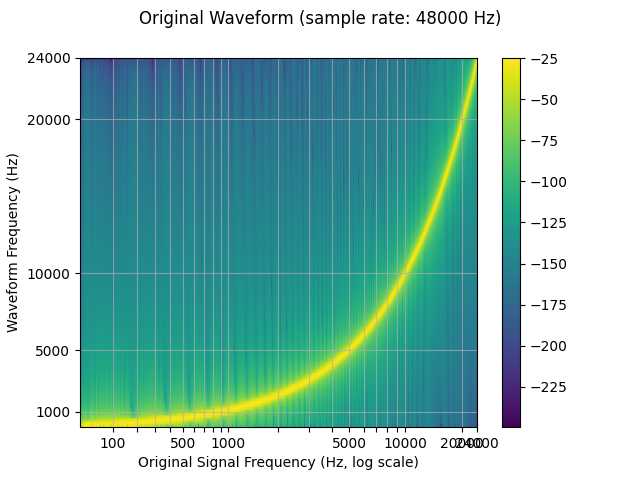
由于有限数量的样本只能表示有限数量的频率,重采样并不能产生完美的结果,可以通过多种参数来控制其质量和计算速度。我们通过重采样一个对数正弦扫频来演示这些特性,这是一种随时间呈指数增长频率的正弦波。
下图中的频谱图显示了信号的频率表示, 其中 x 轴对应原始波形的频率(以对数刻度表示), y 轴对应所绘制波形的频率, 颜色强度表示振幅。
sample_rate = 48000
waveform = get_sine_sweep(sample_rate)

plot_sweep(waveform, sample_rate, title="Original Waveform")
Audio(waveform.numpy()[0], rate=sample_rate)
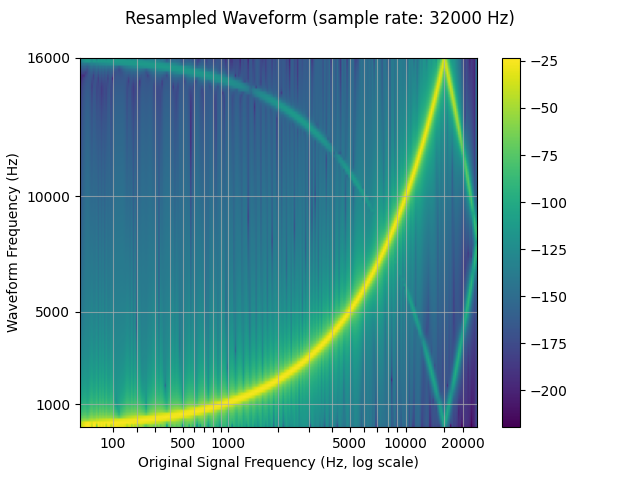
现在我们对它进行重采样(下采样)。
我们观察到,在重采样波形的频谱图中出现了一个伪影,而该伪影在原始波形中并不存在。
resample_rate = 32000
resampler = T.Resample(sample_rate, resample_rate, dtype=waveform.dtype)
resampled_waveform = resampler(waveform)

plot_sweep(resampled_waveform, resample_rate, title="Resampled Waveform")
Audio(resampled_waveform.numpy()[0], rate=resample_rate)
通过参数控制重采样质量
低通滤波器宽度
因为用于插值的滤波器是无限延伸的,所以使用
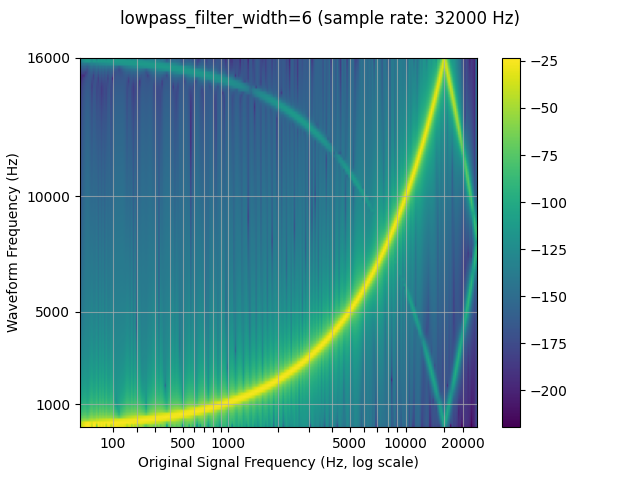
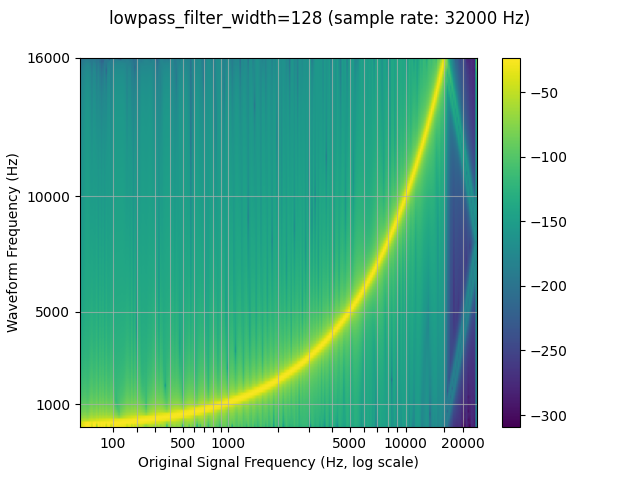
lowpass_filter_width 参数来控制用于窗口插值的滤波器宽度。它也被称为零交叉次数,因为插值在每个时间单位都会穿过零点。使用更大的 lowpass_filter_width 可以提供更尖锐、更精确的滤波器,但计算成本更高。
sample_rate = 48000
resample_rate = 32000

resampled_waveform = F.resample(waveform, sample_rate, resample_rate, lowpass_filter_width=6)
plot_sweep(resampled_waveform, resample_rate, title="lowpass_filter_width=6")
resampled_waveform = F.resample(waveform, sample_rate, resample_rate, lowpass_filter_width=128)
plot_sweep(resampled_waveform, resample_rate, title="lowpass_filter_width=128")
回滚
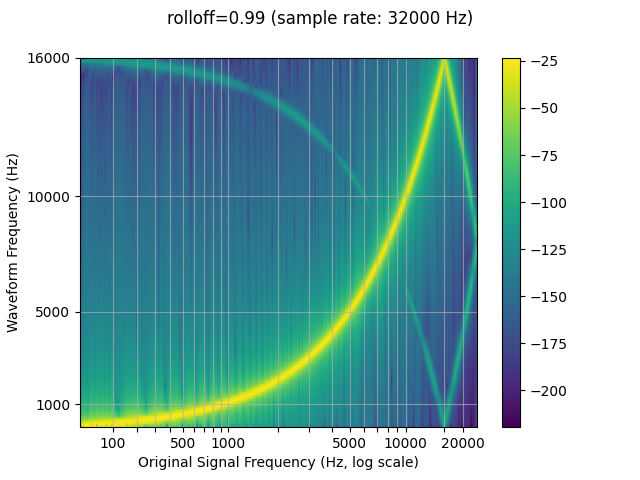
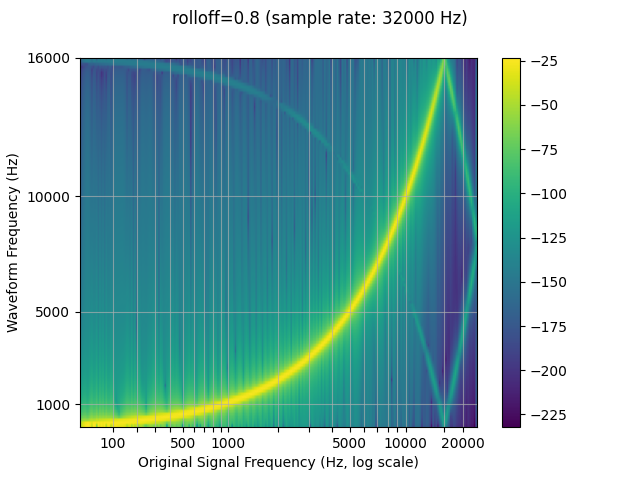
The rolloff 参数表示奈奎斯特频率的一个分数,奈奎斯特频率是给定有限采样率所能表示的最大频率。rolloff 决定了低通滤波器的截止频率,并控制混叠的程度,混叠发生在高于奈奎斯特频率的频率被映射到较低频率时。因此,较低的滚降将减少混叠量,但也同时会降低部分较高频率。
sample_rate = 48000
resample_rate = 32000

resampled_waveform = F.resample(waveform, sample_rate, resample_rate, rolloff=0.99)
plot_sweep(resampled_waveform, resample_rate, title="rolloff=0.99")
resampled_waveform = F.resample(waveform, sample_rate, resample_rate, rolloff=0.8)
plot_sweep(resampled_waveform, resample_rate, title="rolloff=0.8")
窗口函数
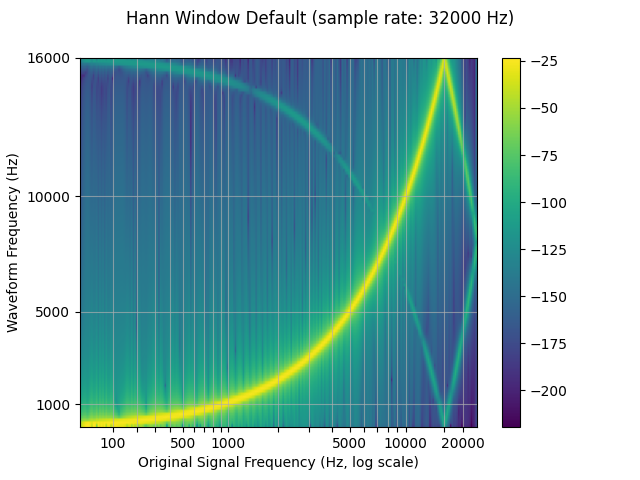
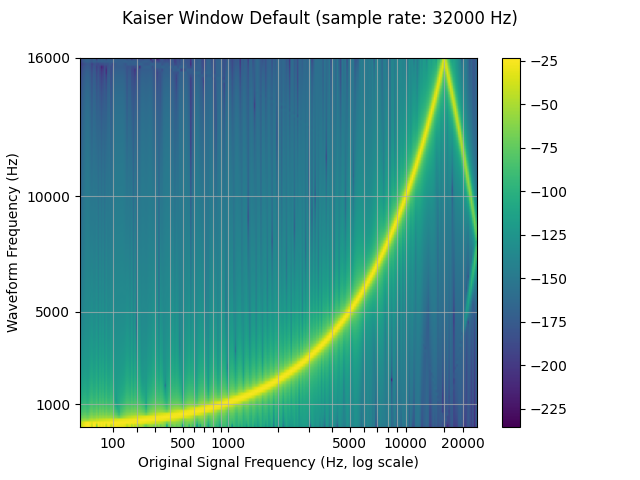
默认情况下,torchaudio 的重采样使用 Hann 窗口滤波器,这是一个加权余弦函数。它还支持 Kaiser 窗口,这是一种接近最优的窗口函数,包含一个额外的
beta 参数,可用于设计滤波器的平滑度和脉冲宽度。这可以通过使用
resampling_method 参数进行控制。
sample_rate = 48000
resample_rate = 32000

resampled_waveform = F.resample(waveform, sample_rate, resample_rate, resampling_method="sinc_interpolation")
plot_sweep(resampled_waveform, resample_rate, title="Hann Window Default")
resampled_waveform = F.resample(waveform, sample_rate, resample_rate, resampling_method="kaiser_window")
plot_sweep(resampled_waveform, resample_rate, title="Kaiser Window Default")
与librosa的对比
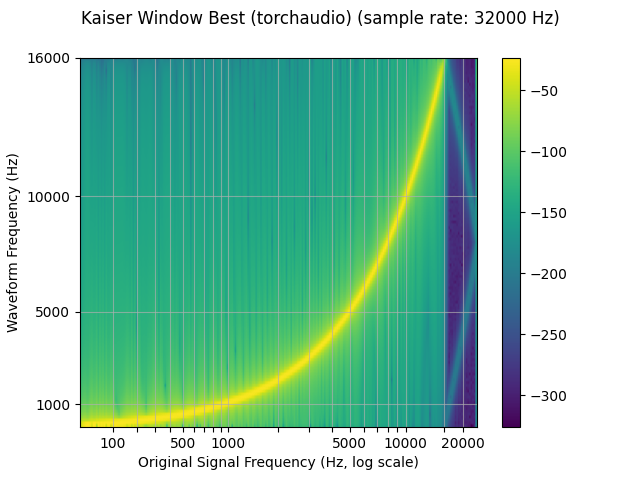
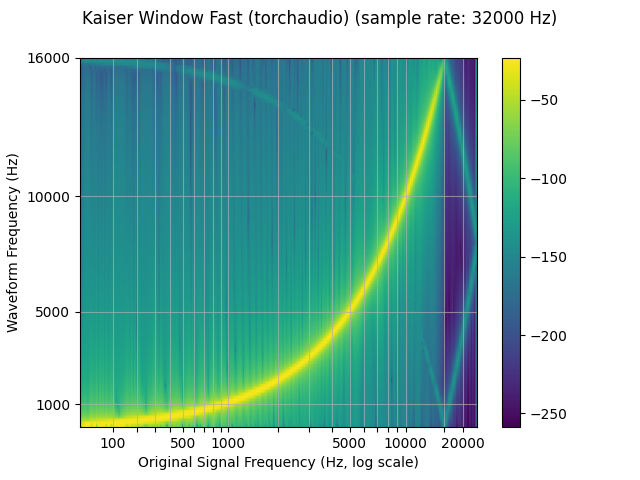
torchaudio’s resample 函数可以用来生成与 librosa (resampy) 的 Kaiser 窗重采样类似的结果,但会带有一些噪声
sample_rate = 48000
resample_rate = 32000
kaiser_best
resampled_waveform = F.resample(
    waveform,
    sample_rate,
    resample_rate,
    lowpass_filter_width=64,
    rolloff=0.9475937167399596,
    resampling_method="kaiser_window",
    beta=14.769656459379492,
)
plot_sweep(resampled_waveform, resample_rate, title="Kaiser Window Best (torchaudio)")
librosa_resampled_waveform = torch.from_numpy(
    librosa.resample(waveform.squeeze().numpy(), orig_sr=sample_rate, target_sr=resample_rate, res_type="kaiser_best")
).unsqueeze(0)
plot_sweep(librosa_resampled_waveform, resample_rate, title="Kaiser Window Best (librosa)")
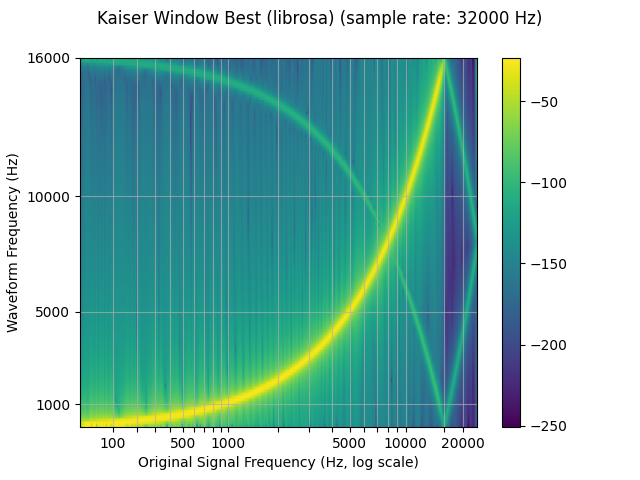
mse = torch.square(resampled_waveform - librosa_resampled_waveform).mean().item()
print("torchaudio and librosa kaiser best MSE:", mse)
Out:
torchaudio and librosa kaiser best MSE: 2.08069011536601e-06
kaiser_fast
resampled_waveform = F.resample(
    waveform,
    sample_rate,
    resample_rate,
    lowpass_filter_width=16,
    rolloff=0.85,
    resampling_method="kaiser_window",
    beta=8.555504641634386,
)
plot_sweep(resampled_waveform, resample_rate, title="Kaiser Window Fast (torchaudio)")
librosa_resampled_waveform = torch.from_numpy(
    librosa.resample(waveform.squeeze().numpy(), orig_sr=sample_rate, target_sr=resample_rate, res_type="kaiser_fast")
).unsqueeze(0)
plot_sweep(librosa_resampled_waveform, resample_rate, title="Kaiser Window Fast (librosa)")
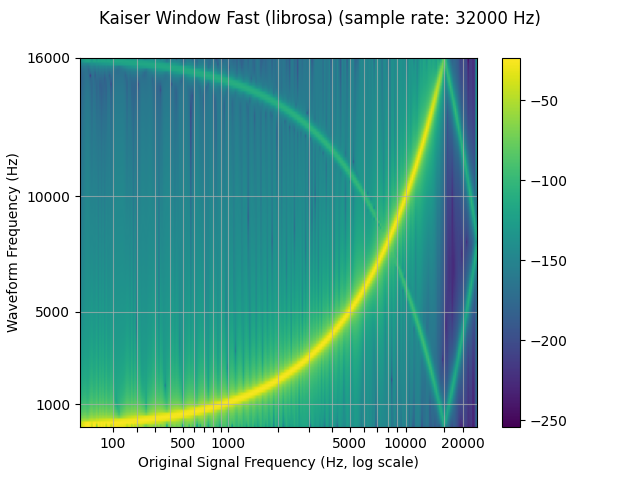
mse = torch.square(resampled_waveform - librosa_resampled_waveform).mean().item()
print("torchaudio and librosa kaiser fast MSE:", mse)
Out:
torchaudio and librosa kaiser fast MSE: 2.5200744248600685e-05
性能基准测试
以下是两个采样率对之间下采样和上采样波形的基准测试。我们展示了lowpass_filter_wdith、窗口类型和采样率可能带来的性能影响。此外,我们还提供了与librosa的kaiser_best和kaiser_fast的对比,使用它们在torchaudio中的相应参数。
进一步阐述结果:
更大的
lowpass_filter_width会导致更大的重采样内核, 因此会增加内核计算和卷积的计算时间使用
kaiser_window会导致比默认值sinc_interpolation更长的计算时间,因为计算中间窗口值更为复杂——采样率与重采样率之间较大的最大公约数(GCD)将导致简化,从而允许使用更小的核并加快核计算速度。
def benchmark_resample(
    method,
    waveform,
    sample_rate,
    resample_rate,
    lowpass_filter_width=6,
    rolloff=0.99,
    resampling_method="sinc_interpolation",
    beta=None,
    librosa_type=None,
    iters=5,
):
    if method == "functional":
        begin = time.monotonic()
        for _ in range(iters):
            F.resample(
                waveform,
                sample_rate,
                resample_rate,
                lowpass_filter_width=lowpass_filter_width,
                rolloff=rolloff,
                resampling_method=resampling_method,
            )
        elapsed = time.monotonic() - begin
        return elapsed / iters
    elif method == "transforms":
        resampler = T.Resample(
            sample_rate,
            resample_rate,
            lowpass_filter_width=lowpass_filter_width,
            rolloff=rolloff,
            resampling_method=resampling_method,
            dtype=waveform.dtype,
        )
        begin = time.monotonic()
        for _ in range(iters):
            resampler(waveform)
        elapsed = time.monotonic() - begin
        return elapsed / iters
    elif method == "librosa":
        waveform_np = waveform.squeeze().numpy()
        begin = time.monotonic()
        for _ in range(iters):
            librosa.resample(waveform_np, orig_sr=sample_rate, target_sr=resample_rate, res_type=librosa_type)
        elapsed = time.monotonic() - begin
        return elapsed / iters
configs = {
    "downsample (48 -> 44.1 kHz)": [48000, 44100],
    "downsample (16 -> 8 kHz)": [16000, 8000],
    "upsample (44.1 -> 48 kHz)": [44100, 48000],
    "upsample (8 -> 16 kHz)": [8000, 16000],
}

for label in configs:
    times, rows = [], []
    sample_rate = configs[label][0]
    resample_rate = configs[label][1]
    waveform = get_sine_sweep(sample_rate)

    # sinc 64 zero-crossings
    f_time = benchmark_resample("functional", waveform, sample_rate, resample_rate, lowpass_filter_width=64)
    t_time = benchmark_resample("transforms", waveform, sample_rate, resample_rate, lowpass_filter_width=64)
    times.append([None, 1000 * f_time, 1000 * t_time])
    rows.append("sinc (width 64)")

    # sinc 6 zero-crossings
    f_time = benchmark_resample("functional", waveform, sample_rate, resample_rate, lowpass_filter_width=16)
    t_time = benchmark_resample("transforms", waveform, sample_rate, resample_rate, lowpass_filter_width=16)
    times.append([None, 1000 * f_time, 1000 * t_time])
    rows.append("sinc (width 16)")

    # kaiser best
    lib_time = benchmark_resample("librosa", waveform, sample_rate, resample_rate, librosa_type="kaiser_best")
    f_time = benchmark_resample(
        "functional",
        waveform,
        sample_rate,
        resample_rate,
        lowpass_filter_width=64,
        rolloff=0.9475937167399596,
        resampling_method="kaiser_window",
        beta=14.769656459379492,
    )
    t_time = benchmark_resample(
        "transforms",
        waveform,
        sample_rate,
        resample_rate,
        lowpass_filter_width=64,
        rolloff=0.9475937167399596,
        resampling_method="kaiser_window",
        beta=14.769656459379492,
    )
    times.append([1000 * lib_time, 1000 * f_time, 1000 * t_time])
    rows.append("kaiser_best")

    # kaiser fast
    lib_time = benchmark_resample("librosa", waveform, sample_rate, resample_rate, librosa_type="kaiser_fast")
    f_time = benchmark_resample(
        "functional",
        waveform,
        sample_rate,
        resample_rate,
        lowpass_filter_width=16,
        rolloff=0.85,
        resampling_method="kaiser_window",
        beta=8.555504641634386,
    )
    t_time = benchmark_resample(
        "transforms",
        waveform,
        sample_rate,
        resample_rate,
        lowpass_filter_width=16,
        rolloff=0.85,
        resampling_method="kaiser_window",
        beta=8.555504641634386,
    )
    times.append([1000 * lib_time, 1000 * f_time, 1000 * t_time])
    rows.append("kaiser_fast")

    df = pd.DataFrame(times, columns=["librosa", "functional", "transforms"], index=rows)
    df.columns = pd.MultiIndex.from_product([[f"{label} time (ms)"], df.columns])

    print(f"torchaudio: {torchaudio.__version__}")
    print(f"librosa: {librosa.__version__}")
    display(df.round(2))
Out:
torchaudio: 0.12.0
librosa: 0.9.1
                downsample (48 -> 44.1 kHz) time (ms)
                                              librosa functional transforms
sinc (width 64)                                   NaN      15.23       0.44
sinc (width 16)                                   NaN      24.25       0.40
kaiser_best                                     34.52      27.59       0.42
kaiser_fast                                     17.58      21.90       0.38
torchaudio: 0.12.0
librosa: 0.9.1
                downsample (16 -> 8 kHz) time (ms)
                                           librosa functional transforms
sinc (width 64)                                NaN       1.21       0.73
sinc (width 16)                                NaN       0.59       0.34
kaiser_best                                  12.36       2.03       0.82
kaiser_fast                                   4.39       0.73       0.36
torchaudio: 0.12.0
librosa: 0.9.1
                upsample (44.1 -> 48 kHz) time (ms)
                                            librosa functional transforms
sinc (width 64)                                 NaN      32.91       0.44
sinc (width 16)                                 NaN      35.77       0.37
kaiser_best                                   35.07      29.64       0.46
kaiser_fast                                   12.37      22.09       0.40
torchaudio: 0.12.0
librosa: 0.9.1
                upsample (8 -> 16 kHz) time (ms)
                                         librosa functional transforms
sinc (width 64)                              NaN       0.78       0.35
sinc (width 16)                              NaN       0.50       0.19
kaiser_best                                12.69       0.90       0.39
kaiser_fast                                 5.28       0.66       0.22
脚本的总运行时间: ( 0 分钟 5.492 秒)