注意
点击 这里 下载完整示例代码
使用 Tacotron2 进行文本转语音
import IPython
import matplotlib
import matplotlib.pyplot as plt
概述
本教程展示了如何使用 torchaudio 中预训练的 Tacotron2 构建文本转语音流程。
文本转语音流程如下:
文本预处理
首先,输入文本被编码为符号列表。在本教程中,我们将使用英文字符和音素作为符号。
频谱图生成
从编码文本生成频谱图。我们使用
Tacotron2模型来完成此操作。时域转换
最后一步是将语谱图转换为波形。从语谱图生成语音的过程也称为声码器(Vocoder)。在本教程中,我们使用了三种不同的声码器: WaveRNN、 Griffin-Lim 以及 Nvidia 的 WaveGlow。
下图展示了整个流程。
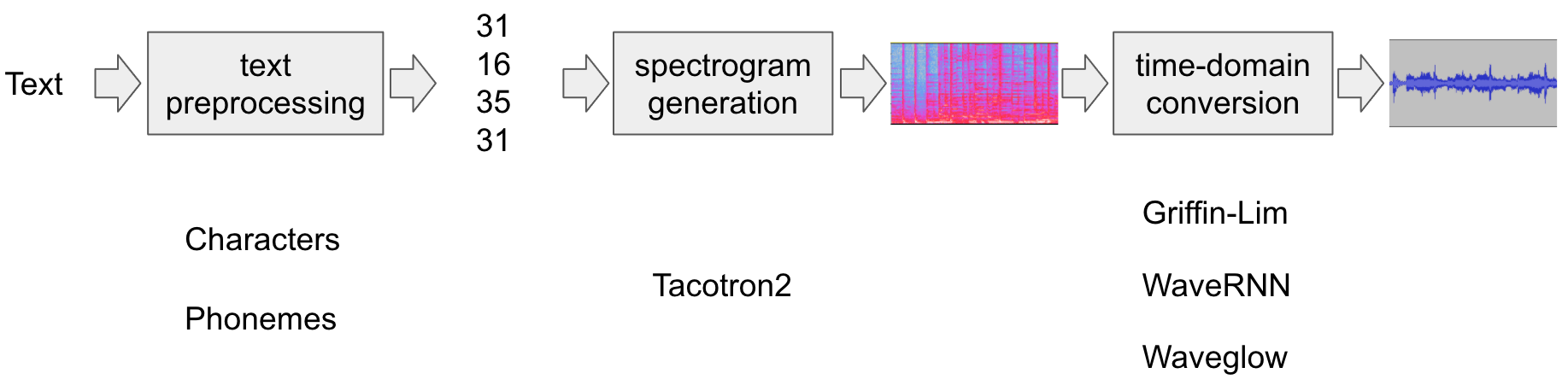
所有相关组件都打包在 torchaudio.pipelines.Tacotron2TTSBundle() 中,
但本教程也将涵盖其背后的处理过程。
准备
首先,我们安装必要的依赖项。除了
torchaudio,还需要 DeepPhonemizer 来执行基于音素的编码。
# When running this example in notebook, install DeepPhonemizer
# !pip3 install deep_phonemizer

import torch
import torchaudio

matplotlib.rcParams["figure.figsize"] = [16.0, 4.8]

torch.random.manual_seed(0)
device = "cuda" if torch.cuda.is_available() else "cpu"

print(torch.__version__)
print(torchaudio.__version__)
print(device)
Out:
1.11.0+cpu
0.11.0+cpu
cpu
文本处理
基于字符的编码
在本节中,我们将介绍基于字符的编码是如何工作的。
由于预训练的 Tacotron2 模型需要特定的符号表集,因此提供了与 torchaudio 中相同的功能。本节主要用于解释编码的基础知识。
首先,我们定义符号集。例如,我们可以使用
'_-!\'(),.:;? abcdefghijklmnopqrstuvwxyz'。然后,我们将输入文本中的每个字符映射到表中对应符号的索引。
以下是此类处理的一个示例。在该示例中,表中未出现的符号将被忽略。
Out:
[19, 16, 23, 23, 26, 11, 34, 26, 29, 23, 15, 2, 11, 31, 16, 35, 31, 11, 31, 26, 11, 30, 27, 16, 16, 14, 19, 2]
如上所述,符号表和索引必须与预训练的 Tacotron2 模型所期望的一致。torchaudio 提供了该转换以及预训练模型。例如,您可以实例化并使用此类转换,如下所示。
Out:
tensor([[19, 16, 23, 23, 26, 11, 34, 26, 29, 23, 15,  2, 11, 31, 16, 35, 31, 11,
         31, 26, 11, 30, 27, 16, 16, 14, 19,  2]])
tensor([28], dtype=torch.int32)
The processor 对象接受文本或文本列表作为输入。
当提供文本列表时,返回的 lengths 变量
表示输出批次中每个处理过的标记的有效长度。
中间表示可按以下方式检索。
Out:
['h', 'e', 'l', 'l', 'o', ' ', 'w', 'o', 'r', 'l', 'd', '!', ' ', 't', 'e', 'x', 't', ' ', 't', 'o', ' ', 's', 'p', 'e', 'e', 'c', 'h', '!']
基于音素的编码
基于音素的编码与基于字符的编码类似,但它使用基于音素的符号表和一个 G2P(字形到音素)模型。
G2P 模型的细节超出了本教程的范围,我们仅查看转换后的效果。
与基于字符的编码情况类似,编码过程应与预训练的 Tacotron2 模型所训练的内容相匹配。
torchaudio 提供了一个用于创建该过程的接口。
以下代码说明了如何创建和使用该流程。在后台,使用 DeepPhonemizer 包创建一个 G2P 模型,并获取 DeepPhonemizer 的作者发布的预训练权重。
Out:
  0%|          | 0.00/63.6M [00:00<?, ?B/s]
  0%|          | 56.0k/63.6M [00:00<03:27, 322kB/s]
  0%|          | 208k/63.6M [00:00<01:43, 645kB/s]
  1%|1         | 696k/63.6M [00:00<00:40, 1.63MB/s]
  4%|3         | 2.52M/63.6M [00:00<00:12, 5.24MB/s]
  7%|6         | 4.27M/63.6M [00:00<00:08, 7.05MB/s]
 10%|9         | 6.07M/63.6M [00:01<00:07, 8.23MB/s]
 12%|#2        | 7.91M/63.6M [00:01<00:06, 9.08MB/s]
 15%|#5        | 9.79M/63.6M [00:01<00:05, 9.69MB/s]
 18%|#8        | 11.7M/63.6M [00:01<00:05, 10.2MB/s]
 21%|##1       | 13.7M/63.6M [00:01<00:04, 10.6MB/s]
 25%|##4       | 15.7M/63.6M [00:01<00:04, 10.9MB/s]
 28%|##7       | 17.7M/63.6M [00:02<00:04, 11.2MB/s]
 31%|###1      | 19.7M/63.6M [00:02<00:03, 12.2MB/s]
 33%|###2      | 20.9M/63.6M [00:02<00:03, 11.6MB/s]
 36%|###5      | 22.9M/63.6M [00:02<00:03, 12.5MB/s]
 38%|###7      | 24.1M/63.6M [00:02<00:03, 11.7MB/s]
 41%|####      | 26.1M/63.6M [00:02<00:03, 12.7MB/s]
 43%|####2     | 27.3M/63.6M [00:02<00:03, 11.9MB/s]
 46%|####6     | 29.3M/63.6M [00:03<00:02, 13.0MB/s]
 48%|####8     | 30.5M/63.6M [00:03<00:02, 12.1MB/s]
 51%|#####1    | 32.6M/63.6M [00:03<00:02, 13.2MB/s]
 53%|#####3    | 33.9M/63.6M [00:03<00:02, 12.3MB/s]
 57%|#####6    | 36.0M/63.6M [00:03<00:02, 13.4MB/s]
 59%|#####8    | 37.2M/63.6M [00:03<00:02, 12.5MB/s]
 62%|######1   | 39.4M/63.6M [00:03<00:01, 13.6MB/s]
 64%|######3   | 40.7M/63.6M [00:04<00:01, 12.7MB/s]
 67%|######7   | 42.8M/63.6M [00:04<00:01, 13.9MB/s]
 69%|######9   | 44.1M/63.6M [00:04<00:01, 12.8MB/s]
 73%|#######2  | 46.3M/63.6M [00:04<00:01, 14.0MB/s]
 75%|#######4  | 47.6M/63.6M [00:04<00:01, 13.0MB/s]
 78%|#######8  | 49.8M/63.6M [00:04<00:01, 14.1MB/s]
 80%|########  | 51.2M/63.6M [00:04<00:00, 13.1MB/s]
 84%|########3 | 53.4M/63.6M [00:04<00:00, 14.3MB/s]
 86%|########5 | 54.7M/63.6M [00:05<00:00, 13.2MB/s]
 89%|########9 | 56.9M/63.6M [00:05<00:00, 14.4MB/s]
 92%|#########1| 58.3M/63.6M [00:05<00:00, 13.4MB/s]
 95%|#########5| 60.5M/63.6M [00:05<00:00, 14.5MB/s]
 97%|#########7| 61.9M/63.6M [00:05<00:00, 13.4MB/s]
100%|##########| 63.6M/63.6M [00:05<00:00, 11.6MB/s]
tensor([[54, 20, 65, 69, 11, 92, 44, 65, 38,  2, 11, 81, 40, 64, 79, 81, 11, 81,
         20, 11, 79, 77, 59, 37,  2]])
tensor([25], dtype=torch.int32)
请注意,编码后的值与基于字符的编码示例不同。
中间表示形式如下所示。
Out:
['HH', 'AH', 'L', 'OW', ' ', 'W', 'ER', 'L', 'D', '!', ' ', 'T', 'EH', 'K', 'S', 'T', ' ', 'T', 'AH', ' ', 'S', 'P', 'IY', 'CH', '!']
频谱图生成
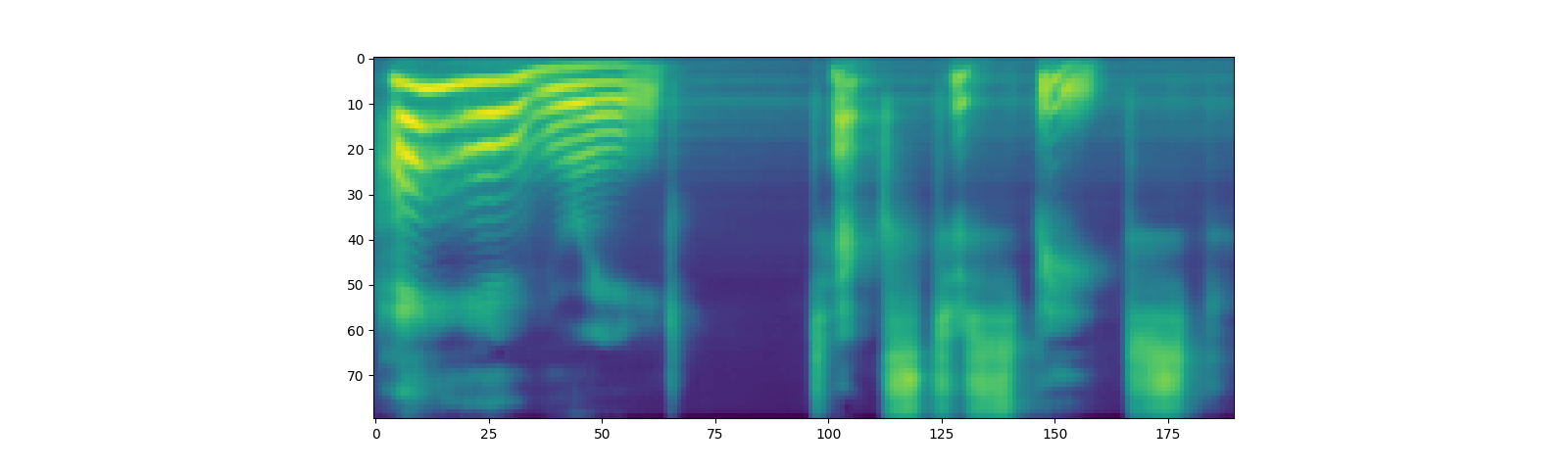
Tacotron2 是我们用来从编码文本生成频谱图的模型。有关该模型的详细信息,请参阅 论文。
使用预训练权重实例化 Tacotron2 模型非常简单,但请注意,输入到 Tacotron2 模型的数据需要经过匹配文本处理器的处理。
torchaudio.pipelines.Tacotron2TTSBundle() 将匹配的模型和处理器捆绑在一起,以便轻松创建流水线。
有关可用的捆绑包及其用法,请参阅 torchaudio.pipelines。
bundle = torchaudio.pipelines.TACOTRON2_WAVERNN_PHONE_LJSPEECH
processor = bundle.get_text_processor()
tacotron2 = bundle.get_tacotron2().to(device)

text = "Hello world! Text to speech!"

with torch.inference_mode():
    processed, lengths = processor(text)
    processed = processed.to(device)
    lengths = lengths.to(device)
    spec, _, _ = tacotron2.infer(processed, lengths)


plt.imshow(spec[0].cpu().detach())
Out:
Downloading: "https://download.pytorch.org/torchaudio/models/tacotron2_english_phonemes_1500_epochs_wavernn_ljspeech.pth" to /root/.cache/torch/hub/checkpoints/tacotron2_english_phonemes_1500_epochs_wavernn_ljspeech.pth

  0%|          | 0.00/107M [00:00<?, ?B/s]
 21%|##1       | 22.9M/107M [00:00<00:00, 240MB/s]
 43%|####2     | 46.1M/107M [00:00<00:00, 242MB/s]
 64%|######4   | 69.2M/107M [00:00<00:00, 241MB/s]
 90%|######### | 96.8M/107M [00:00<00:00, 260MB/s]
100%|##########| 107M/107M [00:00<00:00, 257MB/s]

<matplotlib.image.AxesImage object at 0x7fce43221910>
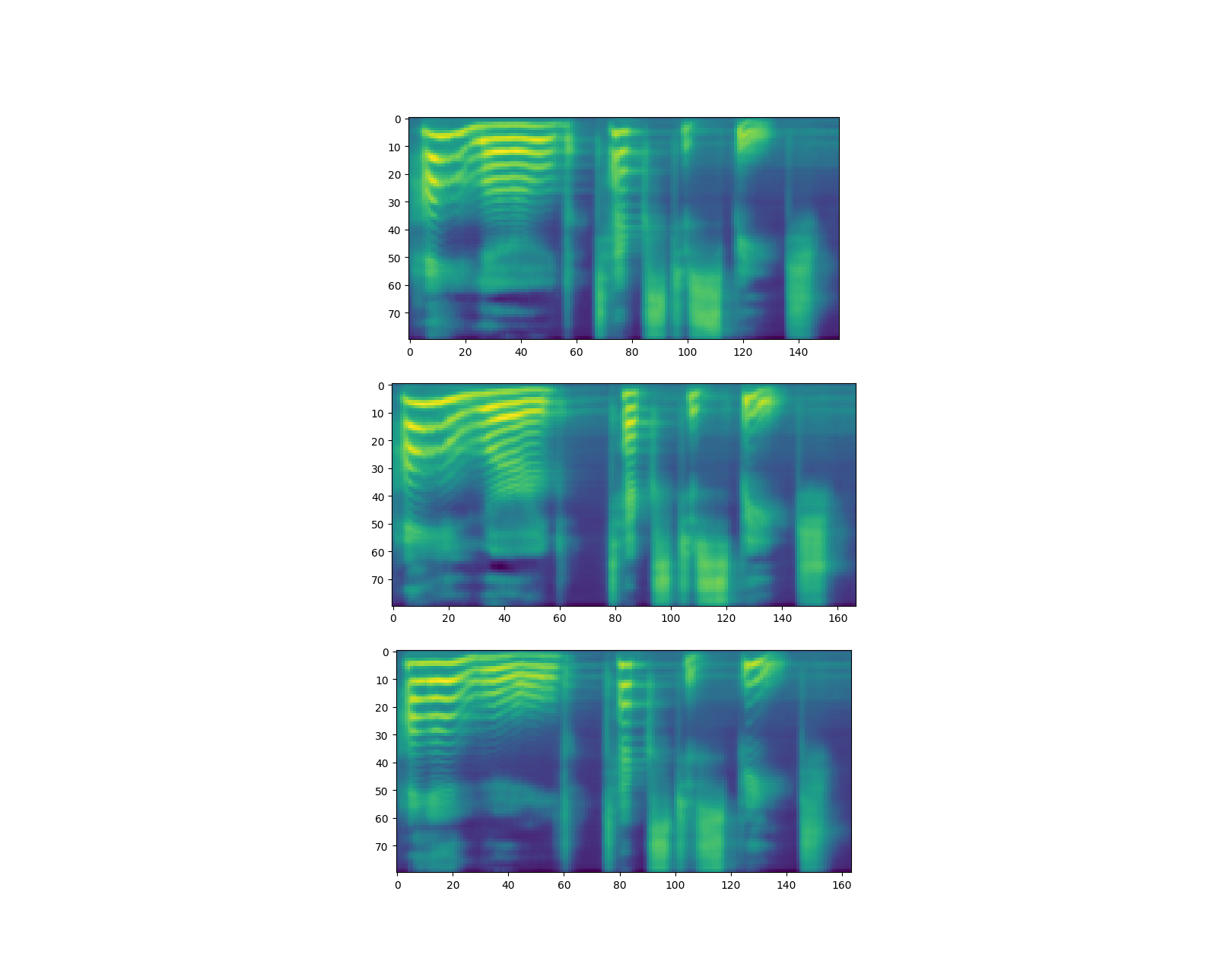
请注意,Tacotron2.infer 方法执行多项式采样,因此生成频谱图的过程会引入随机性。
Out:
torch.Size([80, 155])
torch.Size([80, 167])
torch.Size([80, 164])
波形生成
生成频谱图后,最后一步是从频谱图中恢复波形。
torchaudio 提供基于 GriffinLim 和
WaveRNN 的声码器。
WaveRNN
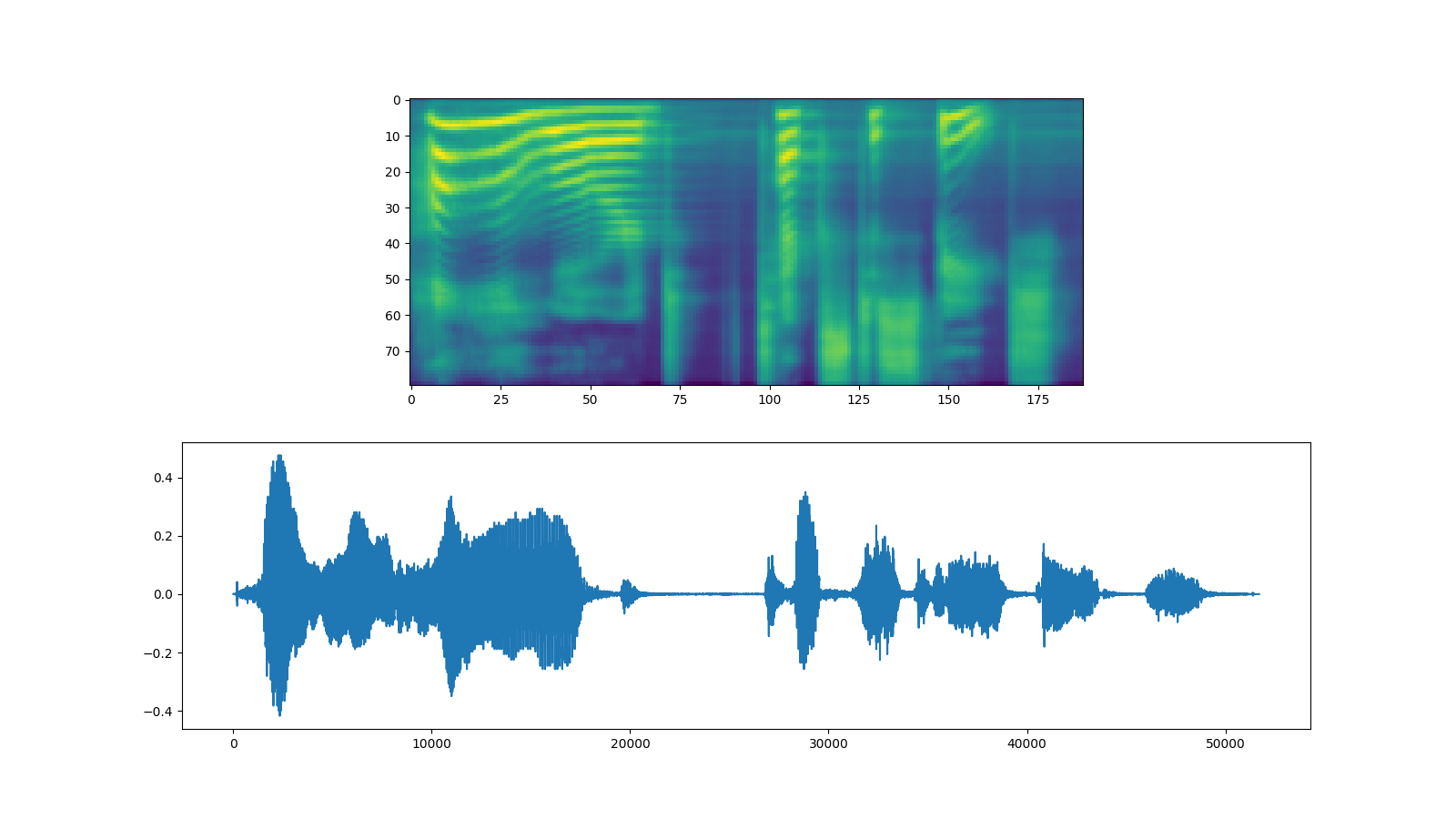
承接上一节,我们可以从同一个捆绑包中实例化匹配的 WaveRNN 模型。
bundle = torchaudio.pipelines.TACOTRON2_WAVERNN_PHONE_LJSPEECH

processor = bundle.get_text_processor()
tacotron2 = bundle.get_tacotron2().to(device)
vocoder = bundle.get_vocoder().to(device)

text = "Hello world! Text to speech!"

with torch.inference_mode():
    processed, lengths = processor(text)
    processed = processed.to(device)
    lengths = lengths.to(device)
    spec, spec_lengths, _ = tacotron2.infer(processed, lengths)
    waveforms, lengths = vocoder(spec, spec_lengths)

fig, [ax1, ax2] = plt.subplots(2, 1, figsize=(16, 9))
ax1.imshow(spec[0].cpu().detach())
ax2.plot(waveforms[0].cpu().detach())

torchaudio.save("_assets/output_wavernn.wav", waveforms[0:1].cpu(), sample_rate=vocoder.sample_rate)
IPython.display.Audio("_assets/output_wavernn.wav")
Out:
Downloading: "https://download.pytorch.org/torchaudio/models/wavernn_10k_epochs_8bits_ljspeech.pth" to /root/.cache/torch/hub/checkpoints/wavernn_10k_epochs_8bits_ljspeech.pth

  0%|          | 0.00/16.7M [00:00<?, ?B/s]
 29%|##9       | 4.87M/16.7M [00:00<00:00, 37.5MB/s]
 96%|#########5| 16.0M/16.7M [00:00<00:00, 70.5MB/s]
100%|##########| 16.7M/16.7M [00:00<00:00, 66.6MB/s]
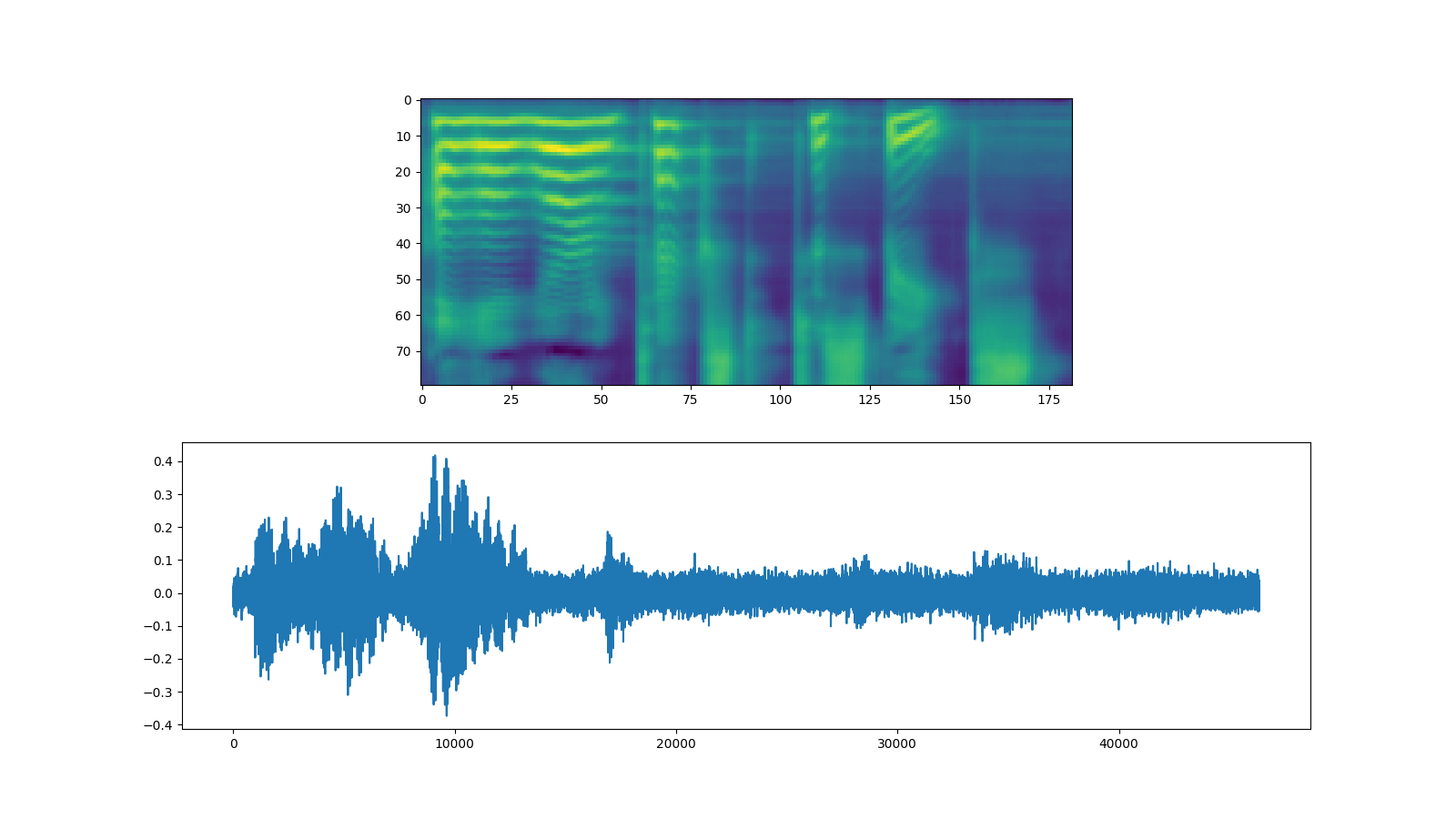
Griffin-Lim
使用 Griffin-Lim 声码器与 WaveRNN 相同。您可以使用 get_vocoder 方法实例化声码器对象并传入频谱图。
bundle = torchaudio.pipelines.TACOTRON2_GRIFFINLIM_PHONE_LJSPEECH

processor = bundle.get_text_processor()
tacotron2 = bundle.get_tacotron2().to(device)
vocoder = bundle.get_vocoder().to(device)

with torch.inference_mode():
    processed, lengths = processor(text)
    processed = processed.to(device)
    lengths = lengths.to(device)
    spec, spec_lengths, _ = tacotron2.infer(processed, lengths)
waveforms, lengths = vocoder(spec, spec_lengths)

fig, [ax1, ax2] = plt.subplots(2, 1, figsize=(16, 9))
ax1.imshow(spec[0].cpu().detach())
ax2.plot(waveforms[0].cpu().detach())

torchaudio.save(
    "_assets/output_griffinlim.wav",
    waveforms[0:1].cpu(),
    sample_rate=vocoder.sample_rate,
)
IPython.display.Audio("_assets/output_griffinlim.wav")
Out:
Downloading: "https://download.pytorch.org/torchaudio/models/tacotron2_english_phonemes_1500_epochs_ljspeech.pth" to /root/.cache/torch/hub/checkpoints/tacotron2_english_phonemes_1500_epochs_ljspeech.pth

  0%|          | 0.00/107M [00:00<?, ?B/s]
 16%|#5        | 16.9M/107M [00:00<00:00, 176MB/s]
 32%|###2      | 34.9M/107M [00:00<00:00, 183MB/s]
 49%|####8     | 52.3M/107M [00:00<00:00, 178MB/s]
 75%|#######5  | 81.1M/107M [00:00<00:00, 226MB/s]
100%|##########| 107M/107M [00:00<00:00, 228MB/s]
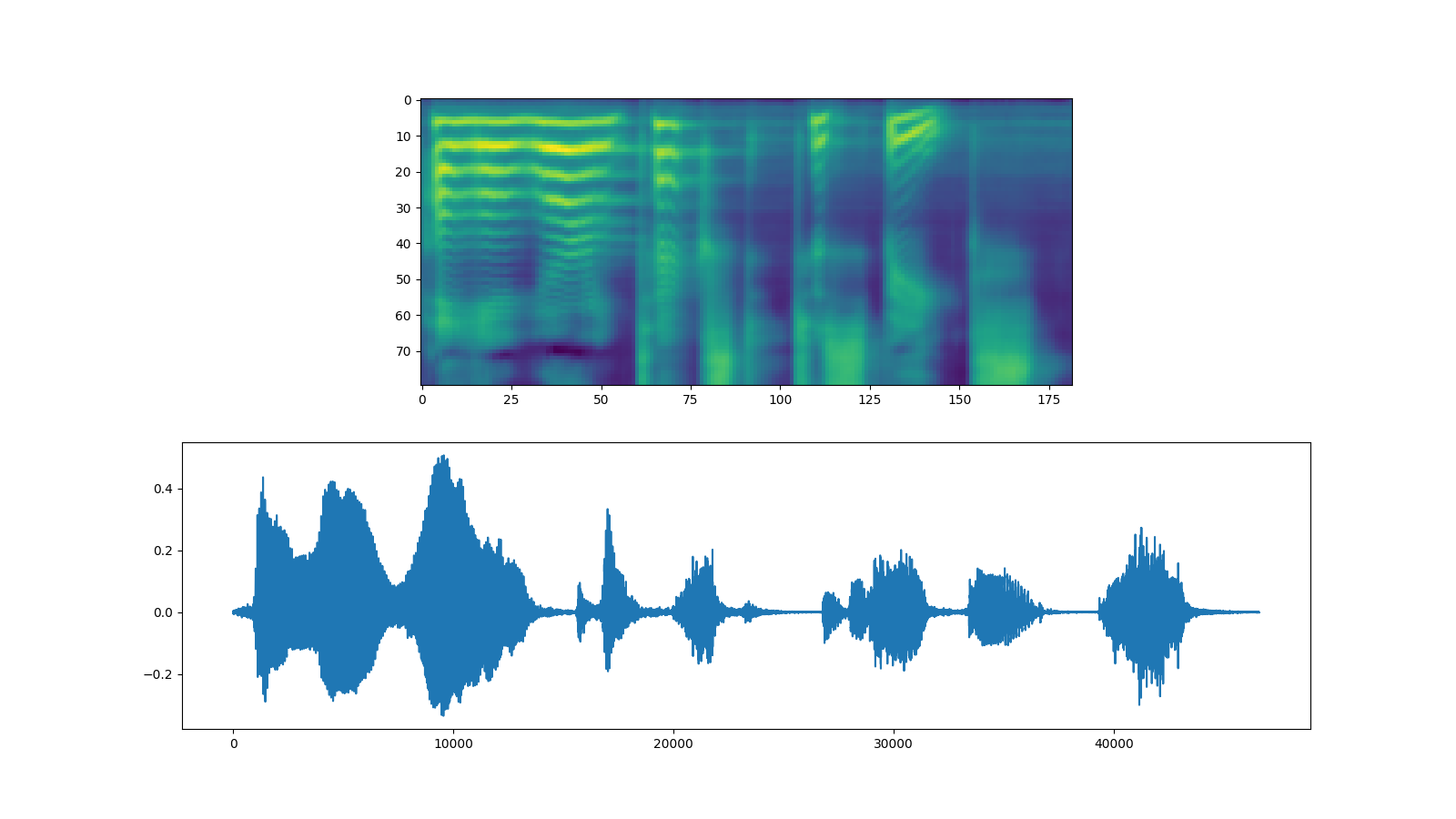
Waveglow
Waveglow 是由 Nvidia 发布的声码器。预训练权重已发布在 Torch Hub 上。可以使用 torch.hub 模块实例化该模型。
# Workaround to load model mapped on GPU
# https://stackoverflow.com/a/61840832
waveglow = torch.hub.load(
    "NVIDIA/DeepLearningExamples:torchhub",
    "nvidia_waveglow",
    model_math="fp32",
    pretrained=False,
)
checkpoint = torch.hub.load_state_dict_from_url(
    "https://api.ngc.nvidia.com/v2/models/nvidia/waveglowpyt_fp32/versions/1/files/nvidia_waveglowpyt_fp32_20190306.pth",  # noqa: E501
    progress=False,
    map_location=device,
)
state_dict = {key.replace("module.", ""): value for key, value in checkpoint["state_dict"].items()}

waveglow.load_state_dict(state_dict)
waveglow = waveglow.remove_weightnorm(waveglow)
waveglow = waveglow.to(device)
waveglow.eval()

with torch.no_grad():
    waveforms = waveglow.infer(spec)

fig, [ax1, ax2] = plt.subplots(2, 1, figsize=(16, 9))
ax1.imshow(spec[0].cpu().detach())
ax2.plot(waveforms[0].cpu().detach())

torchaudio.save("_assets/output_waveglow.wav", waveforms[0:1].cpu(), sample_rate=22050)
IPython.display.Audio("_assets/output_waveglow.wav")
Out:
Downloading: "https://github.com/NVIDIA/DeepLearningExamples/archive/torchhub.zip" to /root/.cache/torch/hub/torchhub.zip
/root/.cache/torch/hub/NVIDIA_DeepLearningExamples_torchhub/PyTorch/Classification/ConvNets/image_classification/models/common.py:13: UserWarning: pytorch_quantization module not found, quantization will not be available
  warnings.warn(
/root/.cache/torch/hub/NVIDIA_DeepLearningExamples_torchhub/PyTorch/Classification/ConvNets/image_classification/models/efficientnet.py:17: UserWarning: pytorch_quantization module not found, quantization will not be available
  warnings.warn(
/root/.cache/torch/hub/NVIDIA_DeepLearningExamples_torchhub/PyTorch/SpeechSynthesis/Tacotron2/waveglow/model.py:55: UserWarning: torch.qr is deprecated in favor of torch.linalg.qr and will be removed in a future PyTorch release.
The boolean parameter 'some' has been replaced with a string parameter 'mode'.
Q, R = torch.qr(A, some)
should be replaced with
Q, R = torch.linalg.qr(A, 'reduced' if some else 'complete') (Triggered internally at  ../aten/src/ATen/native/BatchLinearAlgebra.cpp:1980.)
  W = torch.qr(torch.FloatTensor(c, c).normal_())[0]
Downloading: "https://api.ngc.nvidia.com/v2/models/nvidia/waveglowpyt_fp32/versions/1/files/nvidia_waveglowpyt_fp32_20190306.pth" to /root/.cache/torch/hub/checkpoints/nvidia_waveglowpyt_fp32_20190306.pth
脚本的总运行时间: ( 3 分钟 5.689 秒)